


Gonadorelin vs HCG vs Kisspeptin-10: The HPTA Research Guide
Spend any time researching testosterone, fertility or recovery after androgen use and you will meet gonadorelin, usually mentioned in the same breath as HCG and, more recently, kisspeptin. All three are discussed as ways to keep the testes working while the rest of the hormonal system has gone quiet. Yet they are not interchangeable. Each acts on a different level of the same chain of command, and that one fact explains almost everything about how they differ.
This guide maps that chain, the hypothalamic–pituitary–testicular axis (HPTA), from the top down: why exogenous androgens switch it off, how Gonadorelin Acetate 2 mg (synthetic GnRH) acts at the pituitary, how HCG 5000 IU stands in for LH at the testes, why Kisspeptin-10 sits upstream of both, and why the rhythm of a GnRH signal matters as much as its strength. You will also find the fertility research, where clomiphene fits, a comparison table and the markers a careful user monitors.
One point before we begin. Rogue’s peptides are sold for research purposes only and are not for human consumption. Pharmaceutical HCG and clomiphene are prescription-only medicines, and nothing here is a protocol. Where evidence comes from animal models or small human studies, we say so.
Key takeaways
- The HPTA is a three-level chain: kisspeptin drives pulses of GnRH from the hypothalamus, GnRH drives LH and FSH from the pituitary, and LH and FSH drive testosterone and sperm production in the testes.
- Exogenous androgens suppress the axis through negative feedback: LH and FSH fall, testosterone inside the testes collapses, and sperm output and testicular volume decline.
- Gonadorelin is synthetic GnRH acting at the pituitary; HCG mimics LH at the testes; kisspeptin-10 acts above GnRH.
- Rhythm is everything: pulsatile GnRH stimulates the pituitary, continuous GnRH shuts it down.
- HCG has the deepest clinical record. Human evidence for gonadorelin and kisspeptin outside specialist settings is limited, and much of the rest is preclinical.
- Clomiphene blocks oestrogen feedback so the body’s own GnRH, LH and FSH rise.
- None of this is beginner territory. All of these compounds are prohibited for tested male athletes, and bloodwork plus a doctor belong in every decision.
The HPTA explained: hypothalamus, pituitary, testes
Your testosterone production is governed by three organs that talk through hormones. Endocrinologists call it the hypothalamic–pituitary–gonadal (HPG) axis; in men it is often shortened to HPTA.
Level one: the hypothalamus and GnRH
Specialised neurons in the hypothalamus release gonadotropin-releasing hormone (GnRH), a peptide just ten amino acids long, into a private blood supply that runs straight to the pituitary. GnRH arrives in bursts rather than a steady stream; in adult men a pulse typically comes every one to two hours. Native GnRH is broken down within minutes, so each pulse is a brief, sharp signal followed by silence.
Level two: the pituitary, LH and FSH
GnRH binds receptors on gonadotroph cells in the anterior pituitary, which release two gonadotropins. Luteinising hormone (LH) instructs the Leydig cells of the testes to make testosterone. Follicle-stimulating hormone (FSH) acts on Sertoli cells, which nurture developing sperm. Research suggests faster GnRH pulses favour LH and slower pulses favour FSH.
Level three: the testes
Leydig cells produce most of a man’s testosterone. Much of it stays inside the testes, at concentrations many times higher than in the bloodstream, and that local testosterone, together with FSH, is what sperm production depends on. The seminiferous tubules, where sperm are made, account for most of testicular volume, which is why size tends to track function.
Feedback: the thermostat
Testosterone, and the oestradiol made from it by aromatase, feed back on the hypothalamus and pituitary to slow GnRH, LH and FSH. Sertoli cells add inhibin B, which restrains FSH. Exogenous androgens override exactly this mechanism.
Kisspeptin: the gatekeeper above GnRH
For decades GnRH was considered the top of the chain. Then, in 2003, two research groups independently reported that people with faulty kisspeptin receptors (KISS1R, also called GPR54) fail to go through puberty. Kisspeptin neurons turned out to drive the GnRH neurons themselves, integrating information about sex steroids, energy balance and stress.
Why exogenous androgens shut the HPTA down
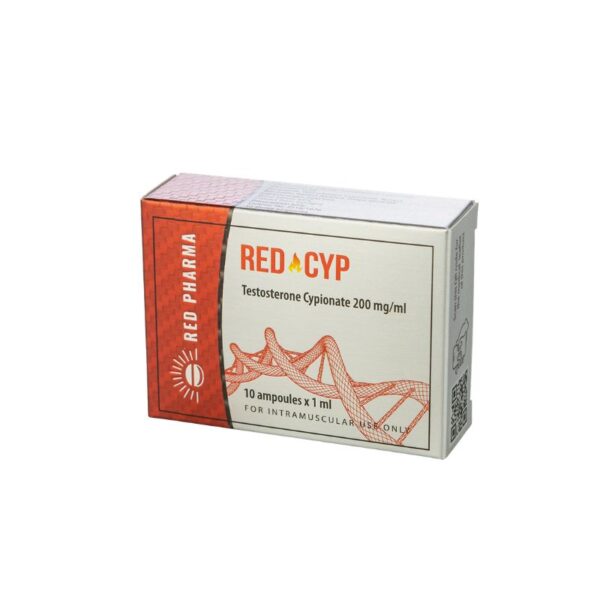
The body cannot tell testosterone it made from testosterone that arrived from outside. When anabolic steroids or testosterone raise androgen levels, the thermostat registers an excess: the hypothalamus slows GnRH, the pituitary cuts LH and FSH, and the testes lose their instructions. Whether the source is a long-acting ester such as Testosterone Cypionate 200 mg/ml, an oral compound or a nandrolone or trenbolone derivative, the principle is the same. Our guide to testosterone enanthate, cypionate and propionate explains why longer esters keep that feedback signal elevated for longer.
What suppression looks like
- LH and FSH fall, often to very low levels on bloodwork.
- Intratesticular testosterone collapses, even while blood testosterone is high.
- Sperm production declines; testosterone has even been investigated as a male contraceptive for this reason.
- Testicular volume shrinks as the tubules lose their stimulus.
- Libido and mood can dip once the external androgen is withdrawn and natural production has not yet returned.
Recovery is slow and individual
When the external androgen clears, the axis has to restart from the top. Clinical reports describe recovery that can take many months and is not certain in every case, especially after long or repeated exposure. Age, baseline function and the compounds involved all influence the outcome. This is why the HPTA sits at the centre of every post cycle therapy discussion.
Context the careful user never skips: anabolic steroids and testosterone are prescription-only medicines in most of Europe, prohibited in tested sport under WADA rules, and not for beginners or teenagers, whose own axis is still maturing. Our guides to oral steroids and advanced injectables show how seriously experienced users treat suppression.
What is gonadorelin? Synthetic GnRH explained
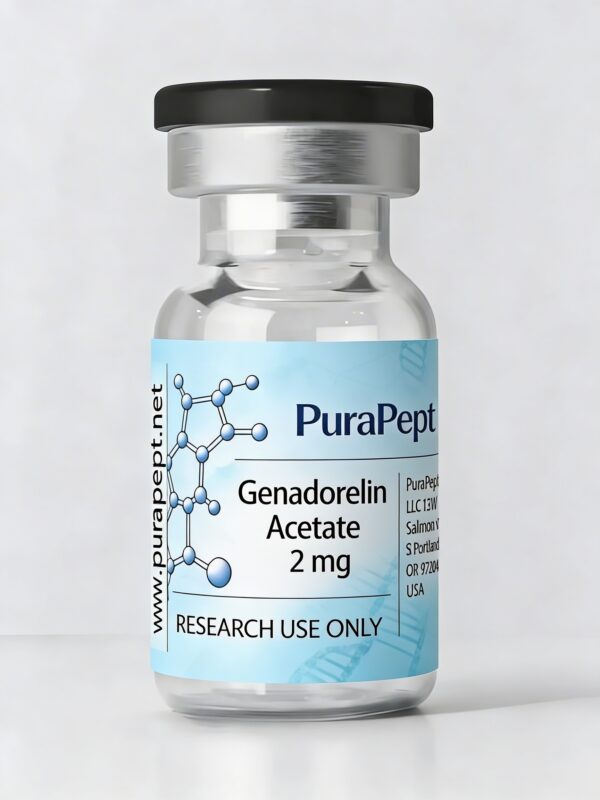
Gonadorelin is the synthetic version of the body’s own GnRH: the same ten amino acids in the same order, with nothing added. That distinguishes it from GnRH agonists used in medicine, such as leuprorelin and triptorelin, which modify the sequence so they resist breakdown and occupy the receptor far longer. Our product is listed as Gonadorelin Acetate, an alternative spelling of the same molecule, supplied as the acetate salt for better handling and solubility.
A short half-life by design
Like native GnRH, gonadorelin is cleaved by enzymes within minutes. In human pharmacology studies a single exposure produces a quick rise in LH, and a smaller rise in FSH, that fades as the peptide clears. That brevity lets researchers recreate the sharp on-off signal the pituitary evolved to read.
An established clinical history
Gonadorelin has two recognised medical roles. In the GnRH stimulation test, it measures how strongly the pituitary responds, helping doctors distinguish a hypothalamic problem from a pituitary one. Delivered through a programmable pump that mimics natural pulses, it has also been used to restore fertility in men and women whose hypothalamus does not produce GnRH, always under specialist supervision.
Why researchers value the native sequence
Because it is identical to the endogenous hormone, gonadorelin is the reference standard against which every GnRH agonist and antagonist is measured. It is used in pituitary cell-culture assays, receptor desensitisation research, HPG-axis modelling and analytical method development.
Pulsatile vs continuous GnRH: the desensitisation paradox
Here is the most counter-intuitive fact in reproductive endocrinology: the same hormone can switch the pituitary on or off depending only on its rhythm. Deliver GnRH in pulses and LH and FSH rise. Deliver it continuously and, after an initial surge, they fall, and testosterone can drop to castrate levels.
The experiment that changed the field
In the late 1970s, Ernst Knobil’s laboratory studied rhesus monkeys whose own GnRH production had been abolished. Intermittent pulses of GnRH restored normal gonadotropin secretion; a continuous infusion shut it down, and returning to pulses brought it back. The pituitary needs the silence between signals as much as the signals themselves.
How desensitisation works
Under constant stimulation, GnRH receptors uncouple from their signalling machinery and are drawn inside the cell. The receptor never gets the gap it needs to reset, and the pituitary stops answering.
From paradox to medicine
That paradox became a drug class. Long-acting GnRH agonists deliberately exploit continuous stimulation to suppress testosterone in prostate cancer and oestrogen in endometriosis, after a brief initial flare. Pump-delivered gonadorelin uses pulsatility for the opposite goal: restoring fertility.
What it means for gonadorelin research
The pattern of exposure, not just the amount, defines the result, and a design that ignores this can blunt the very pituitary response it hopes to measure. The same principle appears with kisspeptin and across the growth hormone axis, as our guides to CJC-1295 and ipamorelin and GHRP-2 vs GHRP-6 explain.
Gonadorelin benefits: what the research has studied
People search for gonadorelin benefits because the idea is elegant: stimulate the pituitary itself, so LH and FSH both rise and the testes receive the full natural message rather than a single substitute. Here is what has actually been studied, and where the evidence stops.
Fertility in hypothalamic hypogonadism
The strongest human evidence comes from hypogonadotropic hypogonadism, in which the hypothalamus fails to send GnRH. In specialist centres, pump-delivered pulsatile gonadorelin has been shown to induce pubertal development, raise testosterone and initiate sperm production in many men, precisely because it restores both LH and FSH. Women with hypothalamic amenorrhoea have been treated the same way to restore ovulation.
Both gonadotropins, not one
Because gonadorelin acts at the pituitary, its theoretical advantage over HCG is breadth: it engages FSH as well as LH, supporting sperm production on both fronts, and it keeps the pituitary in the loop rather than leaving it dormant.
Testicular function alongside androgens: the evidence gap
Interest in gonadorelin as an HCG alternative grew when compounded HCG became harder to obtain in the United States. The appeal is clear, but the human data are thin. The clinical successes used pump delivery in people whose pituitary was healthy but unstimulated. Whether intermittent exposure can preserve testicular volume or sperm output in men whose axis is suppressed by external androgens has not been established in controlled trials, because the androgen is still pressing on the hypothalamus and pituitary.
Laboratory value
In research, gonadorelin’s clearest benefit is precision: a native, fast-clearing signal that isolates pituitary responsiveness. That is why the vial in our peptides collection is supplied as lyophilised, batch-tested reference material.
HCG: mimicking LH at the testes
Human chorionic gonadotropin is a pregnancy hormone made by the placenta. Its relevance to men is structural: HCG and LH share the same alpha subunit and closely related beta subunits, so HCG binds the same receptor on Leydig cells. Extra sugar chains slow its clearance, so where LH circulates for minutes, HCG stays active for a day or more.
A licensed prescription medicine
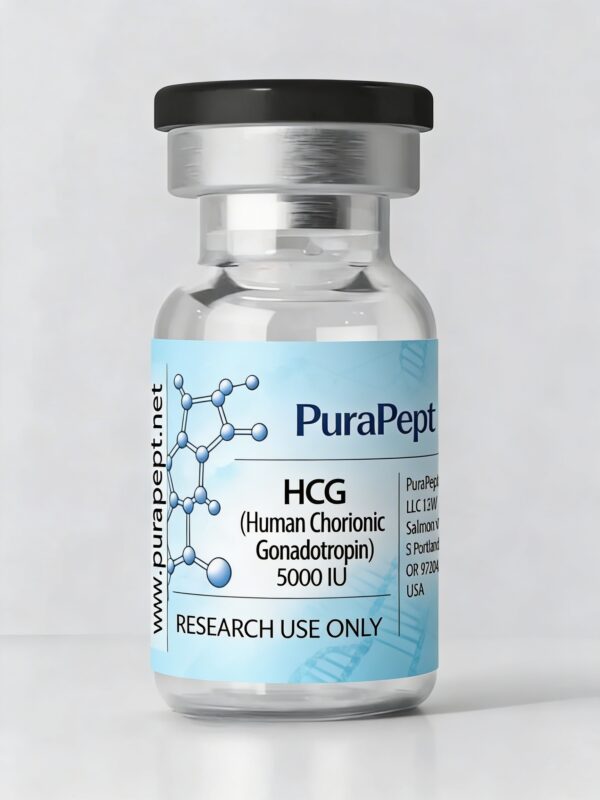
Pharmaceutical HCG is prescription-only, with established uses in triggering ovulation, treating hypogonadotropic hypogonadism in men (often alongside an FSH-containing preparation to induce sperm production) and, in some countries, undescended testes in boys. The HCG (Human Chorionic Gonadotropin) 5000 IU vial in our range is supplied as sealed, batch-tested research material for LH-receptor and steroidogenesis studies.
Testicular volume and intratesticular testosterone
Because HCG acts directly on Leydig cells, it can keep testosterone production running inside the testes even when the pituitary has gone quiet. A small study of healthy men given testosterone, published in the mid-2000s, found that HCG maintained intratesticular testosterone despite suppressed gonadotropins, and retrospective reports from urology practices suggest it may help preserve semen parameters and testicular size. Encouraging, but limited data.
The limits of a substitute
- It bypasses the top of the axis. HCG does nothing to restart GnRH or LH, and the hormones it generates add to negative feedback.
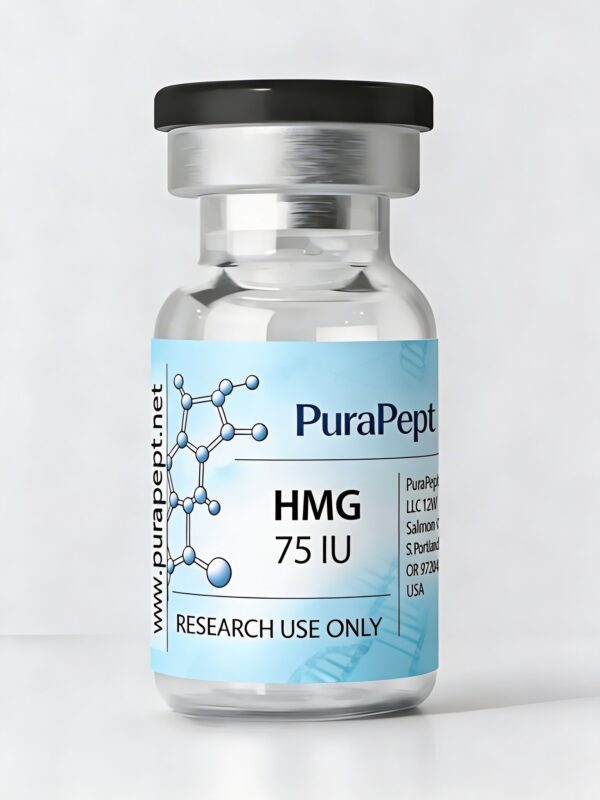
- It supplies LH-like activity only. FSH is not replaced; HMG 75 IU, which carries both FSH and LH activity, is the classic research comparator.
- Leydig cells can desensitise under high or sustained LH-receptor stimulation.
- Oestradiol rises, and breast tenderness or gynaecomastia are listed side effects.
Kisspeptin-10: the switch upstream of GnRH
The KISS1 gene was first described in 1996 as a suppressor of cancer metastasis, named in a nod to the chocolate Kisses made in Hershey, Pennsylvania, where it was discovered. Its role in reproduction emerged only in 2003. Today kisspeptin is regarded as the gatekeeper of the entire reproductive axis.
From kisspeptin-54 to kisspeptin-10
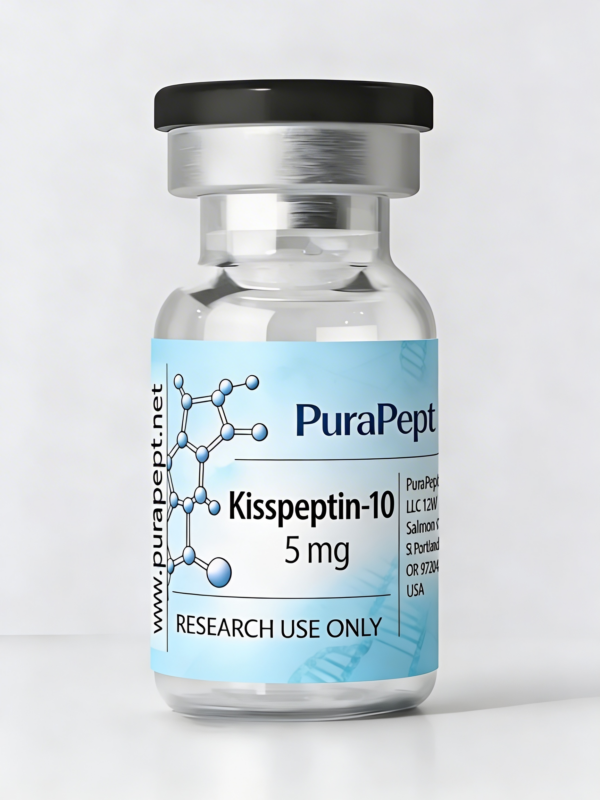
The KISS1 precursor is cut into several active peptides: kisspeptin-54, -14, -13 and -10. Kisspeptin-10 5 mg is the shortest fragment that retains full agonist activity at KISS1R. It is cleared within minutes, whereas kisspeptin-54 persists considerably longer, so the two forms answer different research questions.
What human studies have shown
Kisspeptin is one of the few research peptides with genuine human pharmacology behind it. Research groups in London and Edinburgh have given kisspeptin to volunteers and observed rapid rises in LH, with testosterone following in men. Because it works through the body’s own GnRH neurons, the response depends on an intact hypothalamus and pituitary. In IVF research, kisspeptin-54 has been studied as a gentler trigger for egg maturation in women at risk of ovarian hyperstimulation.
The metabolic connection
Kisspeptin neurons receive signals about energy status, including the fat-derived hormone leptin. When energy intake is chronically too low, kisspeptin signalling falls and the reproductive axis is turned down, a key link between under-fuelling and low testosterone in athletes. Kisspeptin has also been studied in men whose low testosterone accompanies obesity or type 2 diabetes.
Desensitisation again
Kisspeptin obeys the same rhythm rule as GnRH. In animal models, continuous exposure desensitises KISS1R and the LH response fades, and similar tachyphylaxis has been reported in some human studies. Much of what is known about kisspeptin-10 remains preclinical or short-term, and no kisspeptin product is currently a licensed medicine.
Gonadorelin vs HCG vs kisspeptin-10: side by side
Put the three next to each other and the pattern is simple: each acts one level lower in the chain than the last. The table adds HMG and clomiphene for completeness.
| Compound | Class | Where it acts | Effect on your own LH and FSH | Signal duration | Status |
|---|---|---|---|---|---|
| Kisspeptin-10 | Neuropeptide fragment | KISS1R on GnRH neurons (hypothalamus) | Raises both, via the body’s own GnRH | Minutes | Research peptide only |
| Gonadorelin | Synthetic native GnRH | GnRH receptors on the pituitary | Raises both when pulsatile; suppresses when continuous | Minutes | Diagnostic and specialist medicine; research peptide |
| HCG | Glycoprotein gonadotropin | LH receptors on Leydig cells (testes) | Bypasses them; your own LH and FSH stay low | A day or more | Prescription medicine; research vial |
| HMG | Combined gonadotropin preparation | FSH and LH receptors (testes) | Supplies both activities directly; own output not restored | Hours to days | Prescription medicine; research vial |
| Clomiphene | SERM (oral tablet) | Oestrogen receptors in hypothalamus and pituitary | Raises both by removing oestrogen feedback | Days; one isomer lingers for weeks | Prescription medicine |
Gonadorelin vs HCG: the key differences
The honest answer is that they solve different problems. HCG is the more direct and better-documented tool for one job: keeping Leydig cells producing testosterone when LH is absent. Gonadorelin is the more physiological idea, engaging the pituitary so both LH and FSH flow, but it is only as good as the rhythm of exposure and the responsiveness of a pituitary that may be under heavy feedback suppression. HCG’s long action makes it forgiving of timing; gonadorelin’s short action makes timing everything. Neither restarts the hypothalamus.
Where kisspeptin fits
Kisspeptin-10 is the most upstream of the three and the most dependent on the rest of the chain being responsive. In a suppressed axis its signal has to pass through two levels that feedback is actively restraining, so it is primarily a research probe rather than a substitute.
Where clomiphene fits
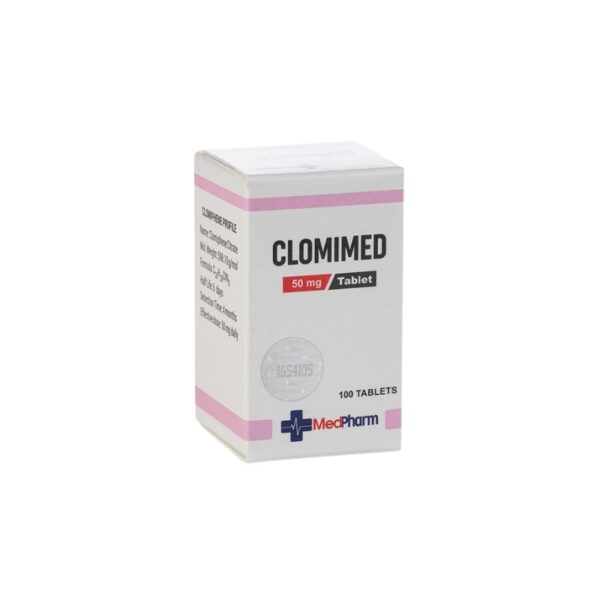
Clomimed (clomiphene 50 mg) works on a different principle. Rather than supplying a hormone, this selective oestrogen receptor modulator occupies oestrogen receptors in the hypothalamus and pituitary, so the brain perceives less oestrogen and releases more GnRH, LH and FSH. It needs the whole axis to be capable of responding, and it can only do its work once external androgens are no longer suppressing it. That is why clomiphene is the long-standing cornerstone of restart strategies, and why HCG is sometimes discussed alongside it, as our post cycle therapy guide to clomiphene and HCG explains. Clomiphene is a prescription medicine with its own side effects, including visual disturbances that call for stopping it and prompt medical review. You will find it in our PCT range, and our testosterone esters guide covers the androgen side of the story.
Side effects and risk management
Here is what research and licensed-medicine labels describe, without minimising or exaggerating.
Gonadorelin
Reported effects include headache, flushing, nausea, abdominal discomfort and injection-site reactions; rare hypersensitivity reactions have been described. The larger risk is functional: sustained exposure can desensitise the pituitary and suppress the hormones it was meant to raise.
HCG
Labels list headache, irritability, fatigue, low mood, fluid retention, breast tenderness or gynaecomastia and injection-site pain, several driven by higher oestradiol. In women it can cause ovarian hyperstimulation and in boys early puberty: this is a potent hormone, not a supplement.
Kisspeptin-10
Short human studies have generally reported kisspeptin to be well tolerated, but they were small, brief and closely supervised. Long-term data do not exist, and research-grade material carries the added uncertainty of purity.
Clomiphene
Visual disturbances such as blurring or floaters, mood changes, hot flushes, headaches and nausea are documented. In men it raises oestradiol along with testosterone.
What the careful user monitors
- LH and FSH: the direct readout of pituitary activity, and the clearest sign of suppression or recovery.
- Total and free testosterone, with SHBG: what the testes produce and how much is available.
- Oestradiol (sensitive assay): it rises with HCG and clomiphene, affecting mood, libido and breast tissue.
- Prolactin: raised prolactin suppresses the axis on its own and should be ruled out.
- Semen analysis and testicular volume: the outcomes that matter if fertility is the goal.
- Haematocrit, lipids, liver function and blood pressure: standard markers for anyone with androgen exposure.
- Thyroid panel: thyroid dysfunction disturbs the HPTA, as our T3 Cytomel guide explains.
Why a doctor belongs in the picture
Low LH can mean androgen suppression, a pituitary disorder or something that needs urgent attention, such as a pituitary tumour, and only proper investigation tells them apart. A doctor, ideally an endocrinologist or andrologist, can interpret your bloodwork, check for contraindications and decide whether any intervention is appropriate at all. Dose, timing and duration belong in that conversation and nowhere else. The rules matter too: HCG and clomiphene are prescription-only medicines, research peptides are not licensed for personal use, and under WADA rules HCG, LH and their releasing factors, gonadorelin among them, are prohibited in men at all times, as is clomiphene. Lifestyle counts as well: poor sleep lowers testosterone, as our DSIP peptide guide discusses, and erectile changes during suppression are covered in our sildenafil vs tadalafil comparison.
Buying GnRH, HCG and kisspeptin: why authenticity matters
Search “buy GnRH” or “buy HCG” and you will find vendors of every description. Counterfeits and underfilled vials are well documented in this category, and the risks are specific to these molecules:
- Tiny fills magnify errors. A 2 mg vial of gonadorelin holds a small lyophilised cake, so any shortfall is proportionally large.
- HCG is fragile. As a glycoprotein, its activity depends on an intact three-dimensional structure. Heat, agitation and freeze-thaw cycles can destroy it while the vial looks unchanged.
- Short neuropeptides degrade quietly. Kisspeptin-10 and gonadorelin are vulnerable to oxidation and fragmentation, and impurity artefacts are easily mistaken for real signal in sensitive assays.
- White powders all look alike. Without batch testing, nobody can tell gonadorelin from a cheaper substitute.
For research, impure material does not just waste money; it invalidates the result. That is why every vial in our PuraPept peptide line is sealed and tamper-evident, EU-manufactured, batch-tested for identity and purity and traceable to the manufacturer’s lot, with discreet, tracked EU delivery in plain packaging. The standard is the same for native-sequence gonadorelin, HCG 5000 IU and kisspeptin-10, and it extends to Clomimed in our hormonal support range and the wider research compounds category.
Frequently asked questions
What is gonadorelin used for?
Gonadorelin is synthetic GnRH, identical to the hormone your hypothalamus releases. Medically it has been used to test pituitary function and, delivered in pulses by pump, to restore fertility when the hypothalamus does not produce GnRH. In research it is the reference standard for GnRH receptor and HPG-axis studies.
Is gonadorelin better than HCG?
Neither is better in general, because they act at different levels. HCG replaces LH directly at the testes and has the stronger clinical record for maintaining testicular testosterone. Gonadorelin stimulates the pituitary to release both LH and FSH, but only when exposure is pulsatile, and evidence alongside external androgens is limited.
Is gonadorelin the same as GnRH?
Yes. Gonadorelin has the same ten-amino-acid sequence as natural GnRH, which is why it is often sold simply as GnRH and occasionally spelled genadorelin. Leuprorelin, triptorelin and other agonists are modified to last longer, which makes them suppressive rather than stimulating.
What does kisspeptin-10 do?
Kisspeptin-10 activates KISS1R on GnRH neurons, prompting them to release GnRH, which in turn raises LH and FSH. Human studies have shown rapid LH increases, but the effect depends on a hypothalamus and pituitary that can respond. Much of its evidence base is preclinical or short-term.
Can HCG prevent testicular atrophy?
Research suggests HCG can help maintain intratesticular testosterone and testicular size when LH is suppressed, because it acts directly on Leydig cells. The evidence comes from small studies and retrospective reports, HCG does not replace FSH, and it can raise oestradiol. It is a prescription medicine that belongs under medical supervision.
Does HCG restart natural testosterone production?
Not on its own. HCG stimulates the testes directly but does nothing to reactivate the hypothalamus or pituitary, and the hormones it generates add to negative feedback. Restarting the axis from the top is the role associated with SERMs such as clomiphene, under a doctor’s guidance.
Are gonadorelin, HCG and kisspeptin banned in sport?
Yes, for tested athletes. WADA prohibits HCG, LH and their releasing factors, including gonadorelin, in male athletes at all times, and the category extends to substances with similar biological effects. Clomiphene is also prohibited at all times.
Where can I buy GnRH for research?
Rogue supplies Gonadorelin Acetate 2 mg, the native GnRH sequence, as a sealed, batch-tested lyophilised vial alongside HCG and kisspeptin-10, all for qualified research use only. Whatever supplier you choose, insist on lot traceability and cold-aware shipping.
The bottom line on gonadorelin, HCG and kisspeptin
The HPTA is a chain of command, and these compounds speak to different links in it. Kisspeptin-10 addresses the GnRH neurons, gonadorelin the pituitary, HCG the testes, and clomiphene changes how the brain reads feedback. The level at which a compound acts decides what it can and cannot do. Gonadorelin’s promise is physiological breadth, LH and FSH together, but only with the right rhythm; HCG’s strength is reliability at a single level; kisspeptin’s value is insight into the very top of the axis. The careful, conscious user respects all of that: bloodwork first, a doctor involved and material that is exactly what the label says.
Rogue’s peptides are sold for research purposes only and are not for human consumption. When authenticity, batch traceability and discreet EU delivery matter, explore the full Rogue peptides collection, from Gonadorelin Acetate 2 mg to Kisspeptin-10 5 mg, and build your research on material you can trust.
This article is for educational purposes only and is not medical advice. Prescription medicines and performance compounds carry real risks; speak to a qualified doctor before using any of them, and never use them if you are under 18.
Products in this guide
-
 +35 Rogue Points
-
 +40 Rogue Points
-
 +35 Rogue Points
-
 +49 Rogue Points
-
 +50 Rogue Points
-
 +29 Rogue Points
Keep reading
 Peptide Research
 Peptide Research
 Peptide Research